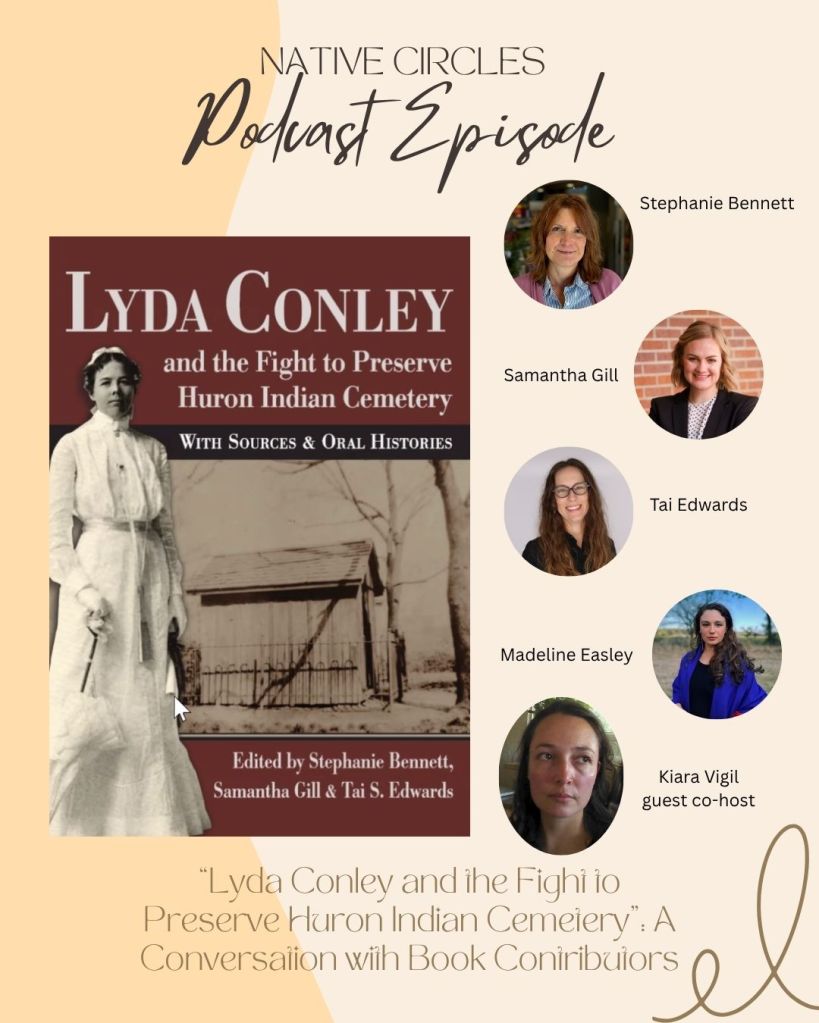
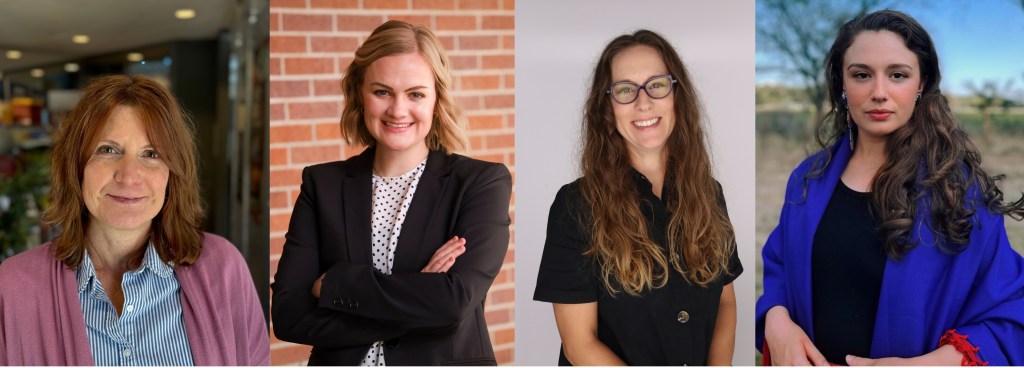
Click this link to listen to Season 3 Episode 19 featuring Dr. Tai Edwards, Stephanie Bennett, Samantha Gill, and Madeline Easley.
In this episode, Dr. Farina King and guest co-host Dr. Kiara Vigil talk with the editors and contributors of the new book Lyda Conley and the Fight to Preserve Huron Indian Cemetery, which tells the story of a trailblazing Wyandot lawyer and activist who defended the burial grounds of her family and ancestors in Kansas City. This work focuses on the life and legacy of Eliza (“Lyda”) Burton Conley, a Wyandot woman whose fight to protect her people’s burial ground continues to shape how we think about federal Indian law, sovereignty, and memory in the United States. Lyda is widely recognized as the first Indigenous woman to argue a case before the U.S. Supreme Court, but as our guests remind us, she never stood alone. Her sisters Ida and Helena, and generations of Wyandot women, shared in the labor of defending their cemetery and their community, both in the courts and on the ground.
Our guests—historian and educator Dr. Tai Edwards, Wyandot Nation of Kansas member and editor Stephanie Bennett, researcher and writer Samantha (Sam) Gill, and Wyandotte playwright Madeline (Maddie) Easley—discuss how their collaborative book brings together biography, archival documents, oral histories, and theater. They talk about reading newspapers and treaties against the grain, navigating access to scattered archives, and recording oral histories with living relatives and tribal leaders. The book offers not just a narrative of Lyda’s life but a source reader and teaching tool that invites more research and classroom conversation.
Together, the editors and contributors frame Lyda’s story as a refusal to accept erasure—what they call “fighting for memory, fighting for honor.” Their work reminds us why this story matters now, in a moment when Indigenous lands, ancestors, and rights are still contested, and when community-based scholarship and art can help chart more just futures.
Stephanie Bennett is a member of the Wyandot Nation of Kansas and the niece of chief emeritus Jan English. She is the descendant of numerous relatives in Huron Indian Cemetery, including her cousin, Darren English. She has been working with the Wyandot Nation of Kansas to preserve and raise awareness of the cemetery since the 1980s. She graduated from the University of Kansas with B.A. degrees in Sociology and Women’s Studies. Bennett has worked as an editor in publishing for nearly 30 years. She is editorial director at David C. Cook Publishing in Colorado Springs, Colorado. She is married to Rich and has two children.
Madeline (Maddie) Easley is a New York–based Wyandotte writer and playwright. Her work tells epic stories to offer frameworks for living in decolonial futures. She is a 2025–2027 Venturous Playwriting Fellow at the Playwrights Center, in partnership with the Venturous Theater Fund and Soho Rep; a 2025 First Peoples Fund Performing Arts Fellow; a 2025 American Indian Community House (AICH) Governor’s Island Artist-in-Residence; and the inaugural Four Directions Playwright Fellow. Her plays and films have been presented at Kansas City Repertory Theatre, Native Voices at the Autry, the American Indian Community House, REACH at the Kennedy Center, the TCL Chinese Theatre, La Jolla Playhouse, and elsewhere. Past residencies, fellowships, and writers’ groups include the New Harmony Project, Peacedale Global Arts, SPACE on Ryder Farm, and the First Peoples Fund Cultural Capital Fellowship. Madeline is a graduate of the University of Evansville and a citizen of the Wyandotte Nation of Oklahoma. Her play Feast for the Dead will world-premiere Off-Broadway at Soho Rep in the 2026-2027 season.
Tai S. Edwards is a history professor and director of the Kansas Studies Institute at Johnson County Community College in the Kansas City metro area. Her publications include Osage Women and Empire: Gender and Power (2018), Lyda Conley and the Fight to Preserve Huron Indian Cemetery: With Sources & Oral Histories (2026), and Shokhí: A Kanza Relative, a Monument, and Rematriation (Fall 2026). She has been involved in many community partnership projects including recording veterans oral histories, helping preserve historic Quindaro (home to the first HBCU west of the Mississippi River), and the Kansas Treaties Project (kansastreaties.com) that provides educational resources about Kanza (Kaw Nation) history and how they were dispossessed of their homeland, the modern-day state of Kansas.
Samantha Gill is a co-editor of Lyda Conley and the Fight to Preserve Huron Indian Cemetery. She is the Adult Services Manager at Hays Public Library in Hays, Kansas. She earned her master’s degree in history from Fort Hays State University in 2016, where she began her research on Lyda Conley’s life and work. When not working and writing, Sam enjoys spending time with her husband and son, and their cat, Honey.
The University Press of Kansas launched the Lyda Conley Series on Trailblazing Indigenous Futures several years ago named in honor of Lyda Conley. Kiara Vigil, Tai Edwards, and Farina King serve as co-editors of the series, and they have hoped for a book to acknowledge and highlight the life and work of Lyda Conley. Finally, that hope is realized with this new book.
Kiara M. Vigil is a professor of American Studies at Amherst College. Kiara’s PhD is in American Culture from the University of Michigan, and she holds master’s degrees from Columbia University’s Teachers’ College and Dartmouth College, as well as a B.A. in History from Tufts University. Her research and teaching interests are grounded in Native American and Indigenous Studies. She is the author of Indigenous Intellectuals: Sovereignty, Citizenship, and the American Imagination, 1890-1930, published by Cambridge University Press (2015). Her articles and essays have appeared in peer-reviewed journals and books, one of which, “Who was Henry Standing Bear? Remembering Lakota Activism from the Early Twentieth Century,” won the Frederick C. Luebke Award for Outstanding Regional Scholarship from the Great Plains Quarterly. Her new book, Natives in Transit: Indian Entertainment, Urban Life, and Activism is a cultural history of Native performance and activist networks from the mid-twentieth century. In addition to her book, Kiara is currently collaborating on a project about the new PBS show “Molly of Denali,” with Julie Dobrow, a scholar at the Tisch College of Civic Life at Tufts University, in a study about how Native Americans have been represented in children’s television programs. She is also working on an article for a special issue of JCMS about “Indigenous Performance Networks: Media, Community, Activism,” where she explores the labor, lives, and activism of Native women during the 1970s.
Resources:
Order the book Lyda Conley and the Fight to Preserve Huron Indian Cemetery
Samantha Gill, blog piece titled, “Lyda Conley: Women’s History Everyone Should Know” (March 2026)
“As a thank you for reading the UPK blog, enjoy 20% off this new book when you order directly from the University Press of Kansas website. Use code: 24BLOG2026 at checkout. Because protecting scholarship and empowering informed citizens starts with readers like you. Good through the end of 2026.”
Native Circles Episode 20: The Lyda Conley Series on Trailblazing Indigenous Futures
Here is a short description of the book:
“A story of resilience, and unwavering courage.
Discover the legacy of Lyda Conley—the first Indigenous woman to argue a case before the U.S. Supreme Court and a fierce defender of her ancestors’ resting place in Kansas. Alongside her sisters, Helena and Ida, Conley spent decades protecting the Wyandot National Burying Ground, standing against federal forces, rebuilding “Fort Conley,” and helping establish legal precedents that continue to shape Indigenous sovereignty today.
Grounded in primary sources, oral histories, and powerful storytelling, this definitive biography by Stephanie Bennett, Samantha Gill, and Tai S. Edwards honors the strength of the Conley sisters and the enduring fight to protect sacred land.”
Here is a longer description of the new book:
“The inspiring story of Lyda Conley, the first Indigenous woman to argue a case before the United States Supreme Court and a trailblazing lawyer and activist who defended the burials of her Wyandot family and ancestors in Kansas City’s Huron Indian Cemetery. Driven by primary sources and oral histories, this biography and source reader is the definitive work on this remarkable woman.
For fifty years, Eliza (“Lyda”) Conley and her two older sisters, Helena and Ida, protected the Huron Indian Cemetery in Kansas City, Kansas, now known as the Wyandot National Burying Ground. A member of the Wyandot Nation of Kansas, Lyda Conley is the first Indigenous woman to argue a case before the United States Supreme Court, where she established legal precedents used to protect Indigenous sovereignty today.
In conjunction with her legal fight, Conley and her sisters spent years physically defending their ancestors’ burials by building a shack in the cemetery they called “Fort Conley.” When a US Marshal tore down their fort in 1911, the sisters simply built another one. While they occupied the grounds, they also tended to cemetery upkeep, maintaining it in pristine condition between 1907 and 1922. Finally, under the leadership of Kansas Senator—and future vice president under Herbert Hoover—Charles Curtis, a member of the Kaw Nation, Congress passed legislation to prevent sale or development of the cemetery’s land in 1913.
Unfortunately, the cemetery needed defending decades later when the Wyandotte Nation (of Oklahoma) attempted to open a casino on the cemetery grounds in the 1990s. The Conley sisters’ Wyandot Nation of Kansas relatives used similar strategies to protect the cemetery once again.
Using primary sources, including images, oral histories, and art, as well as scholarly analysis, Stephanie Bennett, Samantha Gill, and Tai S. Edwards tell the story of Lyda Conley, her sisters, and their perseverance. This book stands as a testament to the Conley sisters, who demonstrated the resilience and courage of Indigenous women who resisted colonialism and protected Indigenous sovereignty, blazing a trail for future generations.”
The co-editors of the Conley Series (featured on episode 20 of Native Circles from a previous season) share the following invitation as a part of the series foreword in the book:
“In 2022, we created the Lyda Conley Series on Trailblazing Indigenous Futures at the University Press of Kansas. At the time, we could not find any other academic series named for an Indigenous woman. A considerable oversight. And yet, in our teaching and research, Lyda Conley regularly reappeared.
Our series honors Eliza ‘Lyda’ Burton Conley (ca. 1868-1946), who spent much of her life carving new pathways in order to protect her Wyandot community and ancestors in Kansas. . . .
Using Lyda Conley’s life and work as a framework, this series features Indigenous trailblazers of the past, present, and future to promote new scholarship within Native American and Indigenous studies that intersects with, but is not limited to, sovereignty, education, law, and gender, as well as literature, culture, activities, and public history. . . .
This book is also a call for more research. If you are working on a project that might be a good fit for this series, please reach out to us or the University Press of Kansas. There are so many stories like Lyda’s waiting to be told.”
-Farina King, Kiara Vigil, and Tai S. Edwards, co-editors of the Lyda Conley Series on Trailblazing Indigenous Futures
Keep reading. Keep writing. Keep learning.

